Space · chart insight
Kepler and K2 account for more than half of confirmed exoplanets
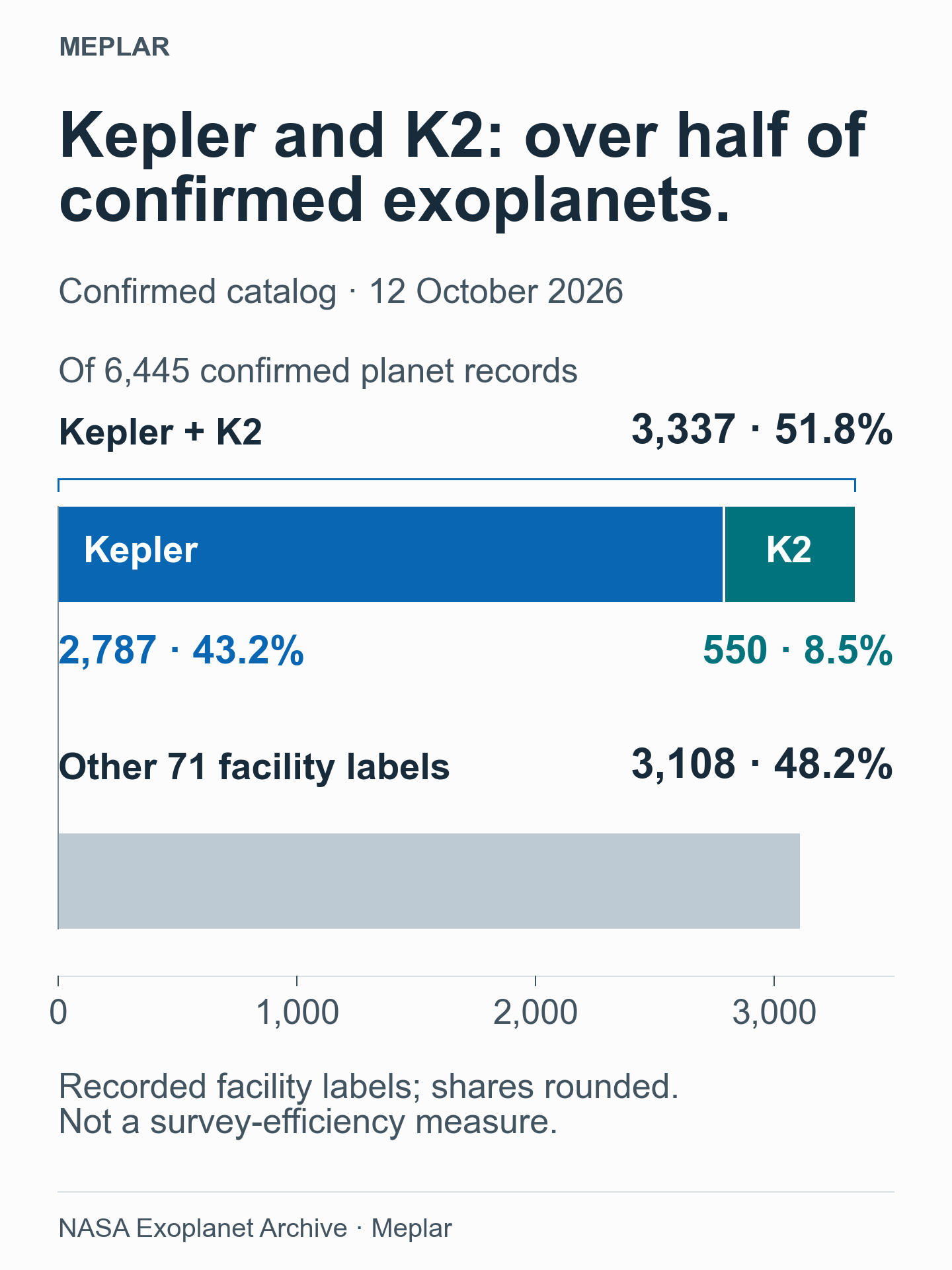
Kepler and K2 are the recorded discovery facilities for 3,337 of the 6,445 confirmed planets in this frozen archive extract: 51.8%. The other 71 facility labels account for 3,108.
 Explore the insight
Source: NASA Exoplanet Archive overview · Original dataset
In context. Counts refer to the archive’s recorded discovery-facility labels, not all planets in the universe, telescope images, searches or detection attempts.
The two highlighted labels together contain more confirmed planet records than the other 71 labels combined. TESS, with 1,008 planets, is the largest of those other categories. The categories are recorded discovery-facility labels, rather than the physical techniques used to detect planets.
This concentration describes what is recorded in this fixed confirmed-planet extract. The file has no exposure-time or target-star denominator, so it cannot establish which survey is most efficient or most complete. A recorded facility label is not a claim of exclusive scientific credit.
Files & formats
- facility_counts.csv — All 73 facility categories, counts and shares.
- chart_data.csv — Three groups shown in the chart.
- exoplanets.csv — Unchanged four-field frozen source extract; 6,445 planets.
- Chart PNG · 1440 × 1920 pixels
- Vector SVG · outlined type; no external font dependency
- Offline reproduction ZIP · exoplanet chart, frozen input, code and source notes
- Complete README · methods, sources and reuse
Method & scope
How it was made
Read the frozen default-planet extract, require a unique planet name and a nonblank discovery facility for every record, then count the original disc_facility strings without relabelling or merging them. For the chart, retain Kepler and K2 separately and sum the other 71 categories. Divide 3,337 by 6,445 and round only the displayed percentage to one decimal.
Definitions & limits
- All 6,445 planet names are unique. There are 73 nonblank recorded facility categories, and every record is counted once.
- These are confirmed planet records, not planet candidates, star systems, telescope images or observing attempts. No survey-performance or causal claim is made.
- The snapshot was retrieved on 12 October 2026. Discovery years run from 1992 through part of 2026; the graphic is a catalog composition, not a complete-year discovery-rate comparison.
- Discovery facility and discovery method are separate fields. A planet’s recorded discovery facility does not enumerate every contributor or subsequent observation.
- Public factual catalog fields are reused with the archive acknowledgement and citation guidance. No blanket CC0 licence is assigned to archive holdings.
Original analysis and design by Meplar, with AI assistance from ChatGPT/Codex. Tools: Python, the standard-library csv/decimal modules and Matplotlib. I run Meplar.
Fields & examples
recorded_facility | Original discovery-facility string from the archive. |
|---|---|
planet_count | Number of unique confirmed planet records assigned to that label. |
share_pct | planet_count / 6,445 × 100; the CSV retains ten decimal places. |
Sources & reuse
Original sources
- NASA Exoplanet Archive overview
- Archive acknowledgement and citation guidance
- Christiansen et al. (2025), archive overview paper
- Original TAP service
Frozen extract copied unchanged from the previously published Meplar source package. Original query: select pl_name,discoverymethod,disc_year,disc_facility from ps where default_flag=1 . TAP endpoint: https://exoplanetarchive.ipac.caltech.edu/TAP/sync ; format csv. No new download was performed for this chart.
This research has made use of the NASA Exoplanet Archive, which is operated by the California Institute of Technology, under contract with the National Aeronautics and Space Administration under the Exoplanet Exploration Program. Archive overview: Christiansen et al. (2025), The Planetary Science Journal, https://doi.org/10.3847/PSJ/ade3c2 . Retain acknowledgement and citation guidance: https://exoplanetarchive.ipac.caltech.edu/docs/acknowledge.html . Public downloadable factual fields only; no survey images, light curves, papers or third-party artwork. No blanket CC0 licence is asserted. Original Meplar charts/code are separate works; no source endorsement is implied.