Australia / Payments
Debit cards took the lead: Australia, 2007–2025
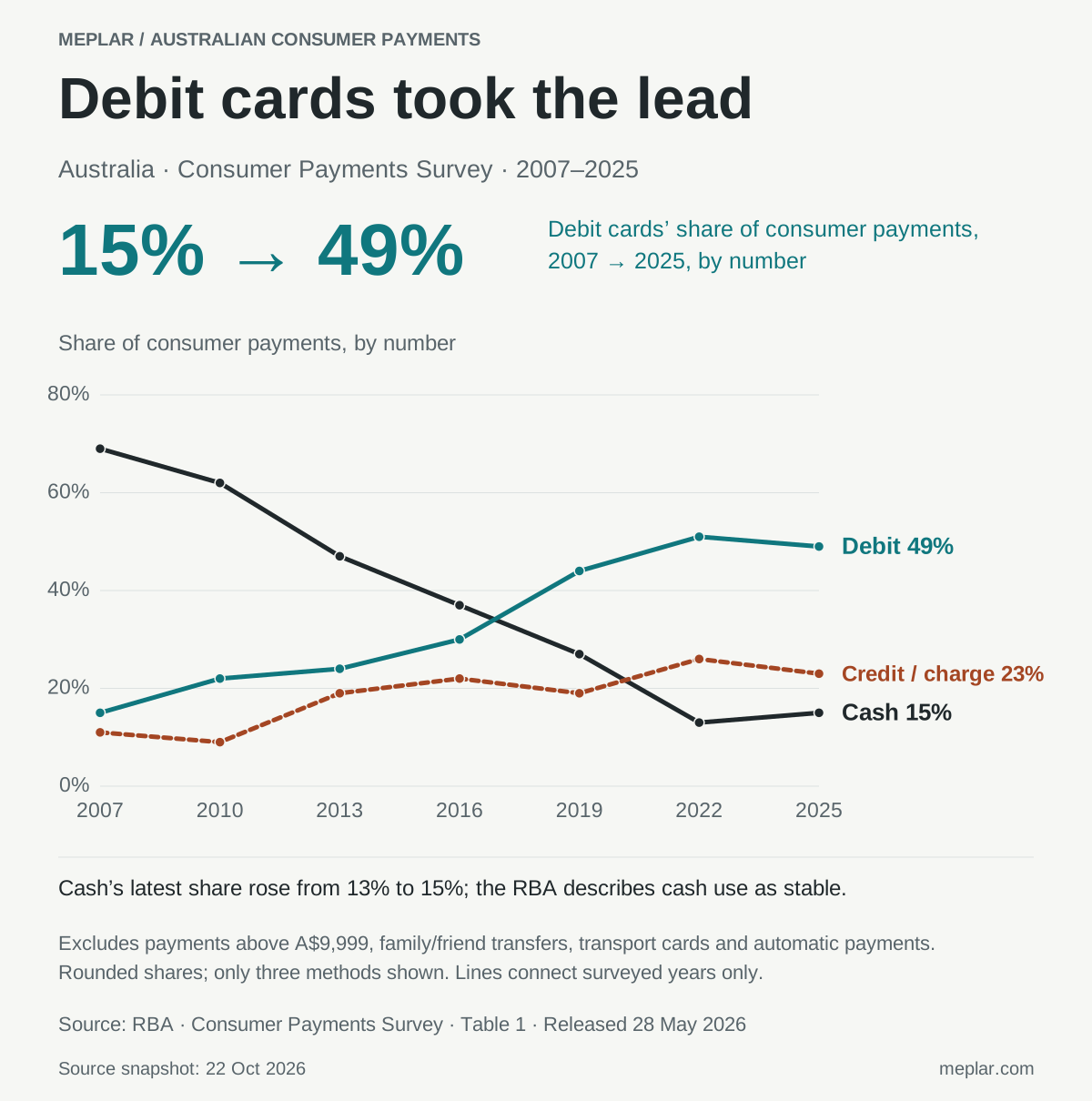
Debit cards rose from 15% of Australian consumer payments in 2007 to 49% in 2025, while cash fell from 69% to 15%. Cash’s latest share was up from 13% in 2022; the RBA describes cash use as stable.
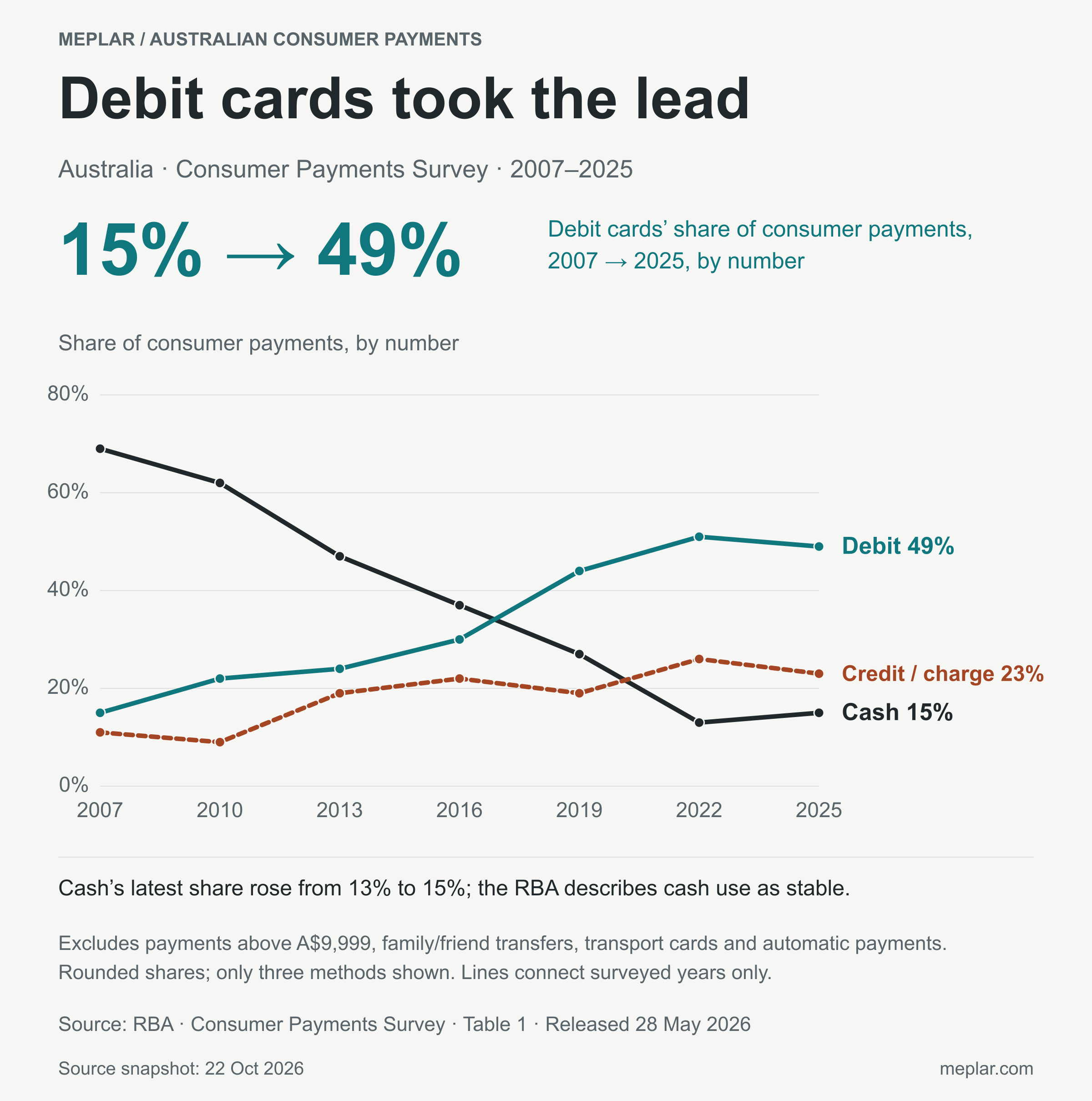
A shift in payment methods.
Debit cards increased from 15% of consumer payments in 2007 to 49% in 2025, measured by number. Cash fell from 69% to 15% over those endpoints; credit and charge cards accounted for 23% in 2025.
The latest cash share was 15%, compared with 13% in 2022. The RBA describes cash use as stable. The data do not show an uninterrupted decline or establish a statistically significant comeback.
All seven survey years
| Survey | Cash | Debit | Credit / charge |
|---|---|---|---|
| 2007 | 69% | 15% | 11% |
| 2010 | 62% | 22% | 9% |
| 2013 | 47% | 24% | 19% |
| 2016 | 37% | 30% | 22% |
| 2019 | 27% | 44% | 19% |
| 2022 | 13% | 51% | 26% |
| 2025 | 15% | 49% | 23% |
Source & method
Source: Table 1 of the RBA’s Consumer Payment Behaviour in Australia, published 28 May 2026. The chart retains all seven surveyed years—2007,2010,2013,2016,2019,2022 and 2025—and three selected methods: cash, debit cards, credit and charge cards. Shares are by number of consumer payments, not payment value, card ownership, population or the entire payments system.
The survey excludes payments above A$9,999, transfers to family and friends, transport cards and automatic payments. In 2025, approximately 1,200 respondents recorded about 14,000 transactions over seven-day diaries, with fieldwork from October to early December.
Rounded source shares are copied without interpolation or renormalisation. Other methods are omitted from the chart. The Card aggregate overlaps debit and credit; do not sum it with those components. Rounded components can differ from the published aggregate—2025 debit 49+credit 23=72, while Card is 73.
Lines connect surveyed years only. No annual observations, significance test or causal explanation are inferred.
Capture provenance & reproduction
Official article was read successfully through the source owner’s web reader. A later unauthenticated attempt to save original HTML returned HTTP403 and was not retried. The frozen rba-table1-web-extract.json is a hashed structured transcription of official Table1, not original response bytes. This adapter makes no new RBA network request.
The fixed-version ZIP includes exact charts, CSVs, source metadata, capture provenance, checksums and an offline reproduction script. It rebuilds both data files and verifies frozen assets; it does not rerender PNGs.