Europe / Population
Malta is the exception: the EU home-leaving gender gap in 2025
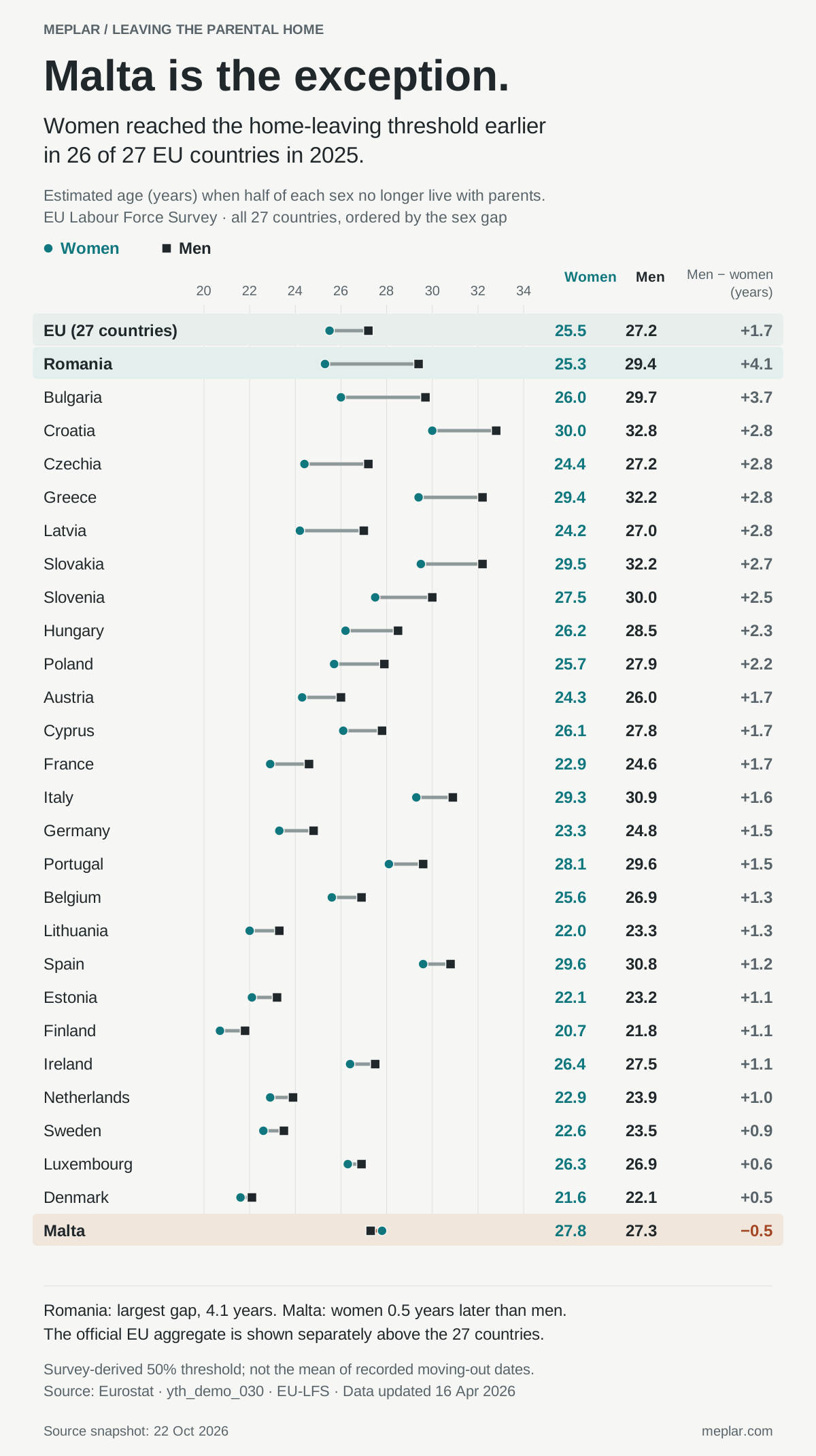
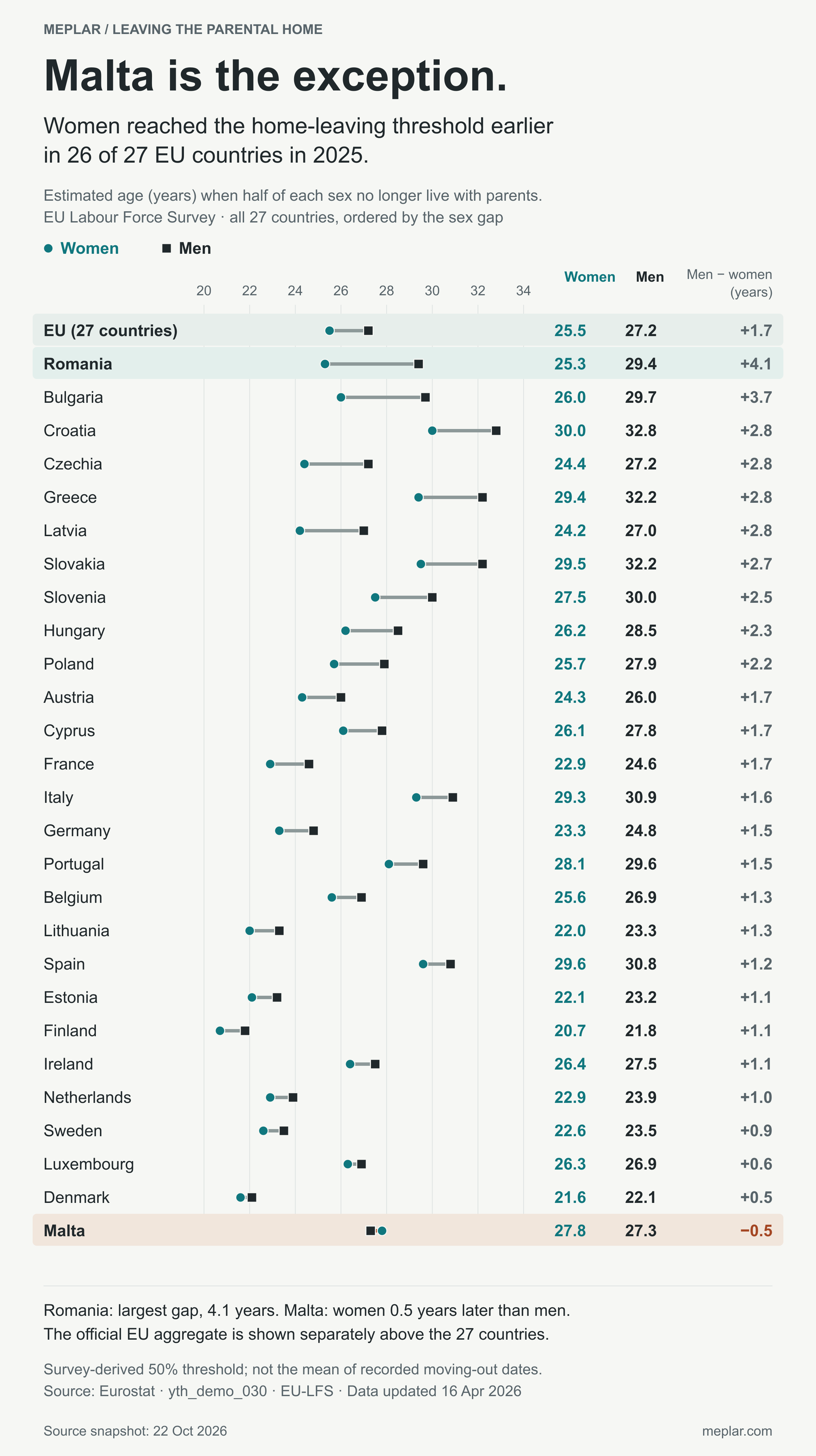
Women reached the home-leaving threshold earlier than men in 26 of 27 EU countries in 2025. Malta reversed the pattern: women 27.8 years, men 27.3. Romania’s 4.1-year gap was the largest.
The exception matters.
Women reached the threshold earlier in 26 of 27 EU countries. Malta was the exception:27.8 years for women and 27.3 for men. Romania had the largest men-minus-women gap,4.1 years.
The official EU aggregate was 25.5 years for women and 27.2 for men. It is supplied by Eurostat and is not an unweighted average of these country values.
Selected comparisons
| Country | Women | Men | Gap |
|---|---|---|---|
| EU (27 countries) | 25.5 | 27.2 | 1.7 |
| Romania | 25.3 | 29.4 | 4.1 |
| Malta | 27.8 | 27.3 | -0.5 |
Source & method
Eurostat’s yth_demo_030 indicator estimates the age at which 50% of the population of each sex no longer live in a household with their parents. It uses EU-LFS co-residence status for ages 15–34; it is not an arithmetic mean of recorded moving-out dates.
All 27 EU members are shown. The chart keeps the official EU 27_2020 aggregate separate, selects female and male observations, and orders countries by men-minus-women gap. Source ages have one decimal; subtraction uses Decimal. All 56 selected female/male observations are present and unflagged in this snapshot.
These are cross-sectional estimates. No individual moving-out record, statistical-significance claim or explanation of causes is supplied.
Capture provenance & reproduction
Source API JSON and official news HTML are frozen originals.
The fixed-version ZIP includes exact charts, CSVs, source metadata, capture provenance, checksums and an offline reproduction script. It rebuilds both data files and verifies frozen assets; it does not rerender PNGs.