India · chart insight
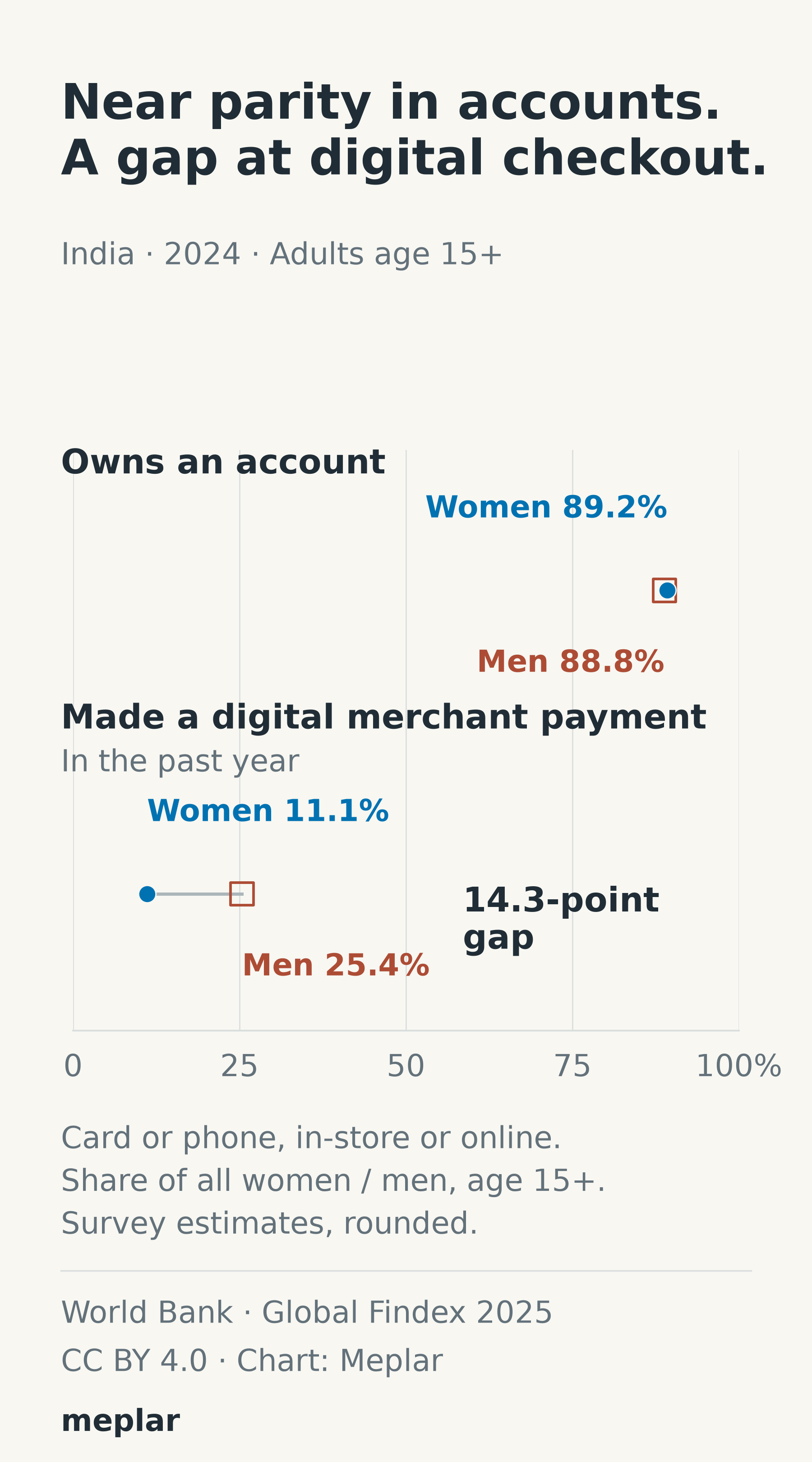
Near parity in accounts. A gap at digital checkout.
Account ownership looks almost the same for women and men in India's Global Findex estimates: about 89% in each group. A different picture appears when the question is whether someone made a digital merchant payment in the past year: 11.1% of women, compared with 25.4% of men.
 Explore the insight
World Bank · Global Findex 2025 · CC BY 4.0 with additional terms · Chart: Meplar · Sources & reuse
In context. Weighted survey estimates for all adults age 15+ in each gender group. The merchant-payment measure records participation in the past year, rather than payment volume.
Ownership and use answer different questions
The estimated account gap is only 0.44 percentage points, with women slightly higher. The merchant-payment gap is 14.26 points, with men higher. Men's merchant-payment rate is about 2.28 times women's. These are descriptions of the published point estimates; the tiny account difference is not a claim of statistical significance.
| Share of adults age 15+ | Women | Men |
|---|---|---|
| Owns an account | 89.25% | 88.81% |
| Made a digital merchant payment | 11.11% | 25.37% |
The distinction matters when reading financial-inclusion statistics. A high account-ownership rate tells us about reported ownership. It does not, by itself, tell us how often people use digital payments or whether they use an account for purchases.
What counts as a digital merchant payment?
The World Bank's glossary includes using a debit or credit card, or a mobile phone, for an in-store purchase, or paying online for an internet purchase. The survey questions refer to the past 12 months. The measure covers people who report the activity, rather than the number or value of their transactions. It is broader than UPI alone and narrower than all digital financial activity.
Both rows use all adults in the relevant gender group as their denominator, rather than only account owners. The account measure includes an individual or joint account at a bank or similar institution, or personal use of a mobile money service in the past year.
Downloads
- chart_data.csv — Four plotted estimates with source proportions, percentages and rounded labels.
- source_extract.csv — The original two India gender rows and selected source columns.
- chart.png — Reviewed original chart, 1800 × 3240 pixels.
- chart.svg — Portable outlined vector chart with no external font dependency.
- chart-editable.svg — Editable vector chart; rendering can depend on local fonts.
- chart.pdf — Vector PDF of the reviewed chart.
- README.md — Full definitions, source URLs, uncertainty, attribution and offline instructions.
- SOURCE_TERMS.txt — World Bank CC BY 4.0 attribution and additional terms.
- SOURCE_PROVENANCE.json — Frozen source hashes, exact selection and public source locations.
- reproduction.zip — Offline chart code, frozen original data and glossary, methodology and font licence.
- SHA256SUMS.txt — SHA-256 hashes of the other public download files.
Method & scope
How the chart was made
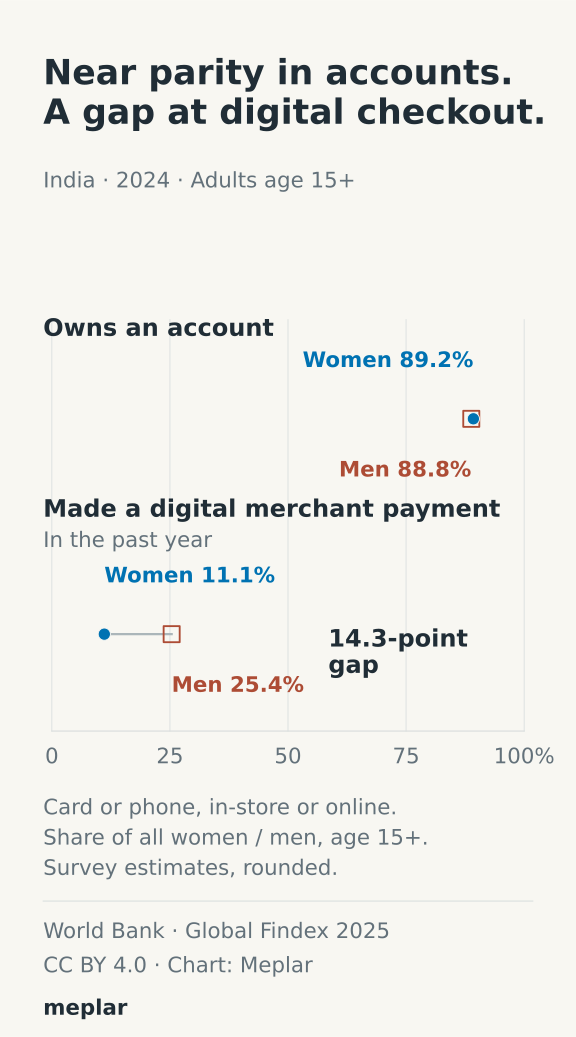
We selected India (IND), survey year 2024, gender rows men and women, and columns account_t_d and merchant_pay from the World Bank's official country-level CSV. The source proportions were multiplied by 100. Points use the unrounded values; chart labels use one decimal place. Both rows share the same 0–100% axis. A filled circle and hollow square keep the nearly overlapping account values visible.
The 2025 database release reports interviews conducted in 2024. Its payment reporting window is the year before each interview, rather than a calendar-year transaction ledger. We used the downloadable CSV and glossary as the numerical and definitional sources.
Survey scope and uncertainty
The target population is civilian, noninstitutionalized adults age 15 and older. India's survey comprised 3,086 face-to-face interviews from 1 August to 29 December 2024. The published methodology excludes the northeast states, remote islands, and Jammu and Kashmir, together accounting for less than 10% of the population. Results are weighted survey estimates.
The aggregate CSV does not supply confidence intervals for these gender-specific estimates. None has been invented. The methodology's 2.1-point maximum whole-sample margin of error for India cannot be reused as an error bar for these gender splits. The chart supports a descriptive comparison, without establishing causes or testing the significance of the gaps.
Fields & examples
country / iso3 / survey_year | India / IND / 2024. The 2025 release reports the 2024 survey. |
|---|---|
release / population / gender | Global Findex 2025; all adults age 15+ in the stated gender group, women or men. |
indicator_code / indicator | account_t_d for account ownership; merchant_pay for reporting a digital merchant payment in the past year. |
source_proportion | The unchanged proportion from the official country-level CSV. |
percent | source_proportion multiplied by 100 using Decimal arithmetic, without intermediate rounding. |
chart_label_percent | Display label rounded to one decimal place. Point positions retain the unrounded percentage. |
The source extract retains countrynewwb, codewb, year, group, group2, account_t_d and merchant_pay. It contains exactly the two selected source rows.
Sources & reuse
Original sources
Source: World Bank, Global Findex Database 2025: Connectivity and Financial Inclusion in the Digital Economy. India 2024, adults age 15+. Official data download · Indicator glossary · Survey methodology.
Reuse: Source data licensed CC BY 4.0, with the World Bank's additional terms. Adaptation by Meplar: selection of country, year, gender and indicators; conversion to percentages; calculated differences; rounded display labels; chart redesign. Meplar's chart, code and text are also CC BY 4.0. No World Bank endorsement implied. Retrieved 17 October 2026.
Complete source notes and offline reproduction · Full source terms